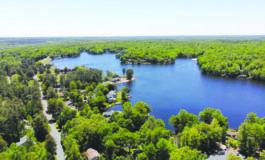





In early Fluvanna history, commerce revolved around the county’s two rivers. One area was a three-mile stretch along the James River in southern Fluvanna called Seven Islands, or Shores.

Shores (Rt, 640, Shores Road) was once a busy place. There were two large mills there and several farming families. The families were large and prosperous. Their stories contain tales of power, money, grudges and even mental illness. Local historian Ellen Miyagawa took a look at the various families of that area.

John Ware

Seven Islands got its name from the many islands located in the James in that part of the river. There aren’t exactly seven islands there; the name comes from the Bible, meaning too many to count.

The earliest mention of Seven Islands was in 1732. John Ware was one of the first settlers there. He was born in Goochland and came to Fluvanna in the 1750s.
His story is like that of many early Fluvanna landowners. He was a justice in Albemarle County. He became a member of Fluvanna’s first Court of Justice. These men were responsible for setting up the county’s first government. Of course, he was a member of the local vestry because you had to be in order to hold public office. He also had a role in the Revolutionary War and represented Fluvanna in the General Assembly. His last public office was that of Fluvanna sheriff in 1796.

He owned about 1,500 acres along this three-mile stretch and built at least two mills along the creeks on his property. He built one of his mills in a hollow near the river so it could be reached by road. To supply water to his mill he blasted rock from the bluff upriver about 1,500 yards. This rock fell into the river, giving rise to the landmark known as “Falling Rock.” He built a primitive canal and applied for permission to build roads. “Ware’s Old Road” is now modern day Rt. 640.
Eventually his children sold off his acreage to several families. Here’s a little about some of them.

Stratton family

The Ware family sold the Stratton family land that included a grocery store on the property. This was a rough and ready place. It sold groceries to river men who were boisterous, unruly and prone to stealing. It didn’t help matters when the storeowner started selling alcohol there.

One time someone stole some leather from one of the nearby boats and buried it near the store. Neighbor Martin Tutwiler discovered it and wrote that he wanted some law enforcement on the river or the thieving might affect business along the James.

Shores family

Thomas Shores came to Fluvanna from Powhatan County. He purchased about 1,100 acres of the original Ware tract. This is how Seven Islands became to be known as Shores.

There was some animosity between the Ware and Shores family. Daughter Polley Ware claimed that Thomas had paid only $1,000 out of the $7,000 he was supposed to pay for the land.

Perhaps in retaliation, Thomas made sure to throw his support behind anyone who was running against John’s son, Washington Ware, for county sheriff. Washington ran for the coveted office for 10 years and lost each time.

Tom Shores build Virgin’s Mill at Seven Islands in 1802. When the James River canal came along in the early 1800s, farmers would bring their wares to the Shores area for shipment down the James.

It was the only mill not destroyed in the Civil War between Richmond and Howardsville in Albemarle County. The area around the mill was very busy. Shores had a blacksmith, cooper, carpenters, and bricklayers. Shoes were made on premises and wool gotten from the 36 head of sheep. Cotton was grown on the property. He also had ten bee stands.

Thomas Shores, a slave owner, was a rich man. When he died at age 86, he owned fine furniture, china, silver and 18 gallons of whiskey.

At his death he gave three of his daughters cash. He gave 500 acres to his favorite grandson. He left 700 acres to his oldest son, Wilson Shores.

Wilson was not a businessman like his father. He was a talented cabinetmaker, but he was in debt constantly and borrowed money from friends and family. He even told nearby neighbor, General John Cocke of Bremo, that he was going to have to wait for his money because his wheat crop failed one year.

Chastaine Shores

Chastaine Shores, the youngest son of Thomas Shores, didn’t inherit anything from Thomas, but his father had given him land before his death.

Chastaine was handsome, very wild and drunk at times. He married a Buckingham girl against her father’s wishes and once rode a horse into a storefront. He often hired slaves from Cocke and Cocke wrote him a letter protesting the treatment of them by Chastaine.

Mariah Shores

Mariah was the youngest daughter of Thomas Shores. She married Martin Tutwiler and they lived at Melrose, one of the homes still standing in that area.

In 1815 Melrose was valued as the most expensive home in the county, even surpassing Cocke’s expansive (and very fine) Bremo plantations.

We can only wonder why Gen. Cocke’s houses were assessed at a lower value. Because of his position and power, could Cocke have influenced the home values? Did Cocke have hard feelings toward the Shores family?

Martin, a slave owner, was a successful businessman. When he died his estate was valued at $34,638. Their household furnishings were even more sumptuous than Thomas’s family. They owned a secretary, 148 books, a pleasure carriage, a silk hat and 411 coat buttons.

Charles Scott

Charles Scott also lived and thrived in the Shores area. He was a member of the Scott family that settled Scottsville in Albemarle County. Charles owned a mill on the Slate River in Buckingham. He bought wheat from across-the-James neighbor Cocke and the two became good friends.

The general may have persuaded him to come to Fluvanna. Cocke thought highly of Scott and called him “as honest a man and as worthy a citizen as the Commonwealth can boast.”

Scott built Middleton Mills at Shores. On his behalf, Cocke petitioned the court to build a road to the mill. Miyagawa writes that he and Cocke and Thomas Shores and other large landowners tried to get wheat donations for the poor, but no one donated anything and the early experiment in social welfare was abandoned.

Johnson Family

The Johnson story could have come straight out of a Bronte novel. John Jedediah Johnson started modestly in the Shores area with 109 acres. When he died, his wife Catherine carried on with business endeavors. She owned two boats on the James that made money hauling freight. Catherine and the couple’s four children eventually spread onto 1300 acres and four adjoining plantations.

Catherine’s grandsons enlisted in the Civil War. John Jedediah II lost an arm. He was furnished with an artificial one that was of no use to him. He couldn’t farm and had to apply for aid from the state. He sold alcohol at his Pleasant Hill farm that earned it the nickname, “Pleasure Hill.”

After the war, the freed slaves left and the Johnson wheat crop failed. The Johnsons sold off their land holdings to make ends meet, mainly to their former slaves.
Hattie Johnson was married to Catherine’s grandson, Francis. They lived at Melrose. Francis died without a will and owed money to the neighboring Tutwiler family for Melrose. Hattie married Richard Harlan, a canal boat driver, and signed away her first husband’s estate to her second husband. The Tutwilers and Hattie’s in-laws sued her to recover debts she owed them. A court ruled she was entitled to Melrose and some acreage, but the rest of the estate was sold at public auction.

Then, Washington Shores (if you remember, he was the one who kept running for sheriff and losing) killed Richard Harlan. Poor Hattie was left with three kids and, by age 27, was a widow for the second time. She never saw justice. Shores pleaded not guilty and the case was dismissed!

Hattie’s daughter by Francis was made a ward of the court and, five years later, a court ruled Hattie a “lunatic” and she also became a ward of the court. Melrose slipped into disrepair and was sold at a public auction in 1883.

Seay family

The Seay family came onto the Shores scene a little later than the original families. Brothers Jack and Clem were millers and purchased Middleton Mills after the Civil War. They married two sisters, Josephine and Mary Bugg.

The Bugg girls came from a family of 14 and their father was a lockkeeper on the canal. The Bugg children fell into the canal so often that their father would exclaim, “Git a pole ‘n fish’em out!”

Jack’s grandson Arthur Seay and wife Nora had seven lively children and called themselves “the Seven Seays of Shores.” Miyagawa writes that the two oldest daughters of the “Seven Seays” were named America and Virginia. Family legend said that Nora wanted to name third daughter “Fluvanna,” but did not, much to the relief of little Nora Page.

The Seay family changed with the times. When the canal traffic diminished and trains rose to prominence, they converted the mill to a train depot where four trains stopped daily.

They still had the mill and needed water for it, so they kept up the canal. Once a year they shut down the mill and drained the canal for maintenance. The neighborhood children would come and catch the fish in the low water.

Arthur also operated a large general store where you could buy anything you needed. Wagons would come from as far away as Palmyra and form a line up the road waiting to unload and load merchandise.

The Middleton Mills burned in 1919. A mill had been in the Shores area for 120 years. Like other communities in Fluvanna that once thrived, Shores is now a quiet country road. There’s not much left except for a few old buildings and homes, cemeteries and, of course, the family stories.

The information in the article was taken from the Bulletin of the Fluvanna County Historical Society, vol. 36. It can be found in the Fluvanna County Library.

Sally Browning was editor of the Fluvanna Review from 2003 to 2008. This story first ran in the Fluvanna Review on Jan. 12, 2006.